
Disclaimer
This is a light-hearted family sports diary, not an official LTA tournament report, a parenting manual, or a peer-reviewed study into the emotional volatility of eight-year-olds holding tennis rackets. All observations are made with affection, mild exhaustion, and the benefit of hindsight. No junior tennis players were harmed in the making of this blog. A parent’s blood pressure, however, remains under review.
The plan for this weekend had looked reassuringly familiar.
Swimming lesson.
An extra martial arts session, because grading is looming and apparently one cannot simply arrive at a belt assessment powered by good intentions and a vague memory of a turning kick.
Then, depending on Sunday’s weather, either Parkrun, cricket for Ilton against Ilminster, or—in the traditional British sporting spirit—standing around outdoors looking at clouds and pretending this is all character-building.
A perfectly normal weekend, in other words.
Then Tim Seymour sent an email.
And just like that, the weekend developed a tennis-shaped complication.
The email was looking for players for the next leg of the Dragon Tour, which has been quietly but steadily becoming one of Somerset junior tennis’s more excellent ideas. The tour was Tim’s brainchild, designed to get more junior players in Somerset playing competitive tennis in a friendly and accessible environment. After last year’s inaugural success, the Dragon Tour has continued to grow. The U8 events in particular seem to attract a healthy number of players across the various tournaments, and the circuit has now expanded beyond that, with an U9 tour and, I believe, an U10 version as well.
The central idea is a very good one: junior players need somewhere to start. Tournament tennis is a different creature from coaching, club sessions or hitting balls nicely in a warm-up.
There are draws, scorekeeping, new opponents, nerves, waiting around, sudden changes of mood and the uncomfortable discovery that not every shot obeys instructions.
The Dragon Tour gives newer players a chance to get used to that environment without it all feeling quite so formal or intimidating.
Our son has played one Dragon Tour event so far, and there is a reason for that. The tour is primarily aimed at children who are starting to compete, while he now has roughly two years of tournament tennis under his belt, having played events ranging from Grade 5 through to Grade 3.
So, for us, the Dragon Tour is not quite as central to his tennis calendar as it might be for other children or parents just beginning that journey.
That said, it still provides valuable match practice, and when an opportunity appears for a well-run local event with proper competitive tennis, he is rarely going to need much persuasion.
After the email arrived, we had a quick family discussion.
“Would you like to play?”
“Yes.”
That was the full committee meeting.
Less than 24 hours later, he was entered. Earlier today, we made our way to Frome.
Yes. Frome.
According to the SatNav, the drive would take roughly 70 minutes. Which is believable in the way all SatNav estimates are believable before actual human beings, traffic lights, roadworks, agricultural machinery and Somerset geography become involved.
There are, broadly speaking, several ways to get from Taunton to Frome.
One can take the route that winds across Somerset through a series of increasingly determined A-roads, passing through places that are perfectly lovely when one is not trying to arrive at a tennis tournament by 9.30 in the morning. It is scenic, certainly. It is also the sort of journey where being stuck behind a tractor for eight miles becomes less an inconvenience and more a lifestyle choice.
Alternatively, one can try to piece together a route that looks more direct on the map and then spend large parts of it wondering whether the mapmaker had ever driven it in a real car. Somerset has a particular talent for roads that seem sensible on paper but, in reality, appear to have been designed by someone sketching with a quill during a thunderstorm.
Or one can surrender to the SatNav entirely, accept its judgement, and trust that the narrow lane it has selected is part of a grander logistical vision rather than an attempt to test your suspension.
We left home around 8.15am, partly to pick up supplies, partly to allow for traffic, and partly because experience has taught us that arriving at a junior sports event late is a remarkably efficient way of turning a child’s nervous system into decorative confetti.
My wife, inconveniently, was on duty in the surgical triage unit, which meant it was down to me to attempt the impossible:
ensuring our son did not cry when things got difficult on court.
This, as any parent of a competitive child knows, is less a task and more a philosophical aspiration.
Still, the journey went smoothly. We arrived in good time and reached the courts for around 9.30am. Naturally, we were the first there.
And when I say first, I do not mean “first players.”
I mean the organiser had not arrived yet.
Excellent. We had beaten the tournament to the tournament.
We took out a ball and our rackets and started hitting a few shots. Gradually, one by one, players, parents and organisers appeared. After some court assembly—smaller courts for U9 orange-ball tennis—the players were called for check-in, and the draw materialised.
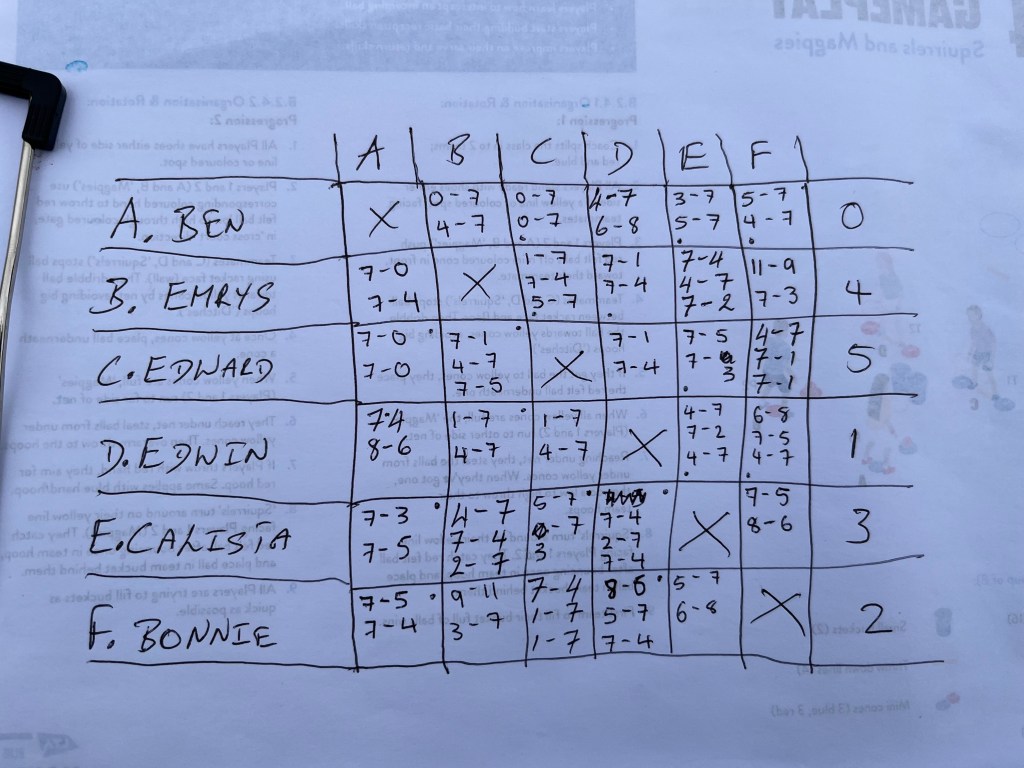
There were six players:
Our son, Bonnie, Calista, Benjamin, Emrys and Edwin.
The format was a single round-robin box: everybody plays everybody. Best of three tie-break sets to seven. Five matches each. A proper morning of tennis, with no hiding and no easy shortcuts.
Match 1: Bonnie — A Nervy Start, Then a Proper Response
Our son began against Bonnie.
Bonnie, born in 2018, is already winning U9 tournaments and is absolutely not to be underestimated. Combine that with our son’s well-established habit of starting tournaments as though his brain is still in the car park, and it had all the ingredients of an awkward opener.
He lost the first set 4–7.
There were tears.
Of course there were tears.
For a brief period, the emotional weather system on court shifted from “light drizzle” to “localised downpour.” But, to his credit, he steadied himself. The frustration came under control, the tennis improved sharply, and he won the next two sets 7–1, 7–1.
A very good comeback, and a useful reminder that tournaments are rarely won in the first five minutes—despite what one’s emotional response may suggest.
Match 2: Edwin — Strong Hitting and Good Rallies
Next up was Edwin, whom I had not seen play before.
The boy can hit a ball.
There were some excellent rallies, and it was pleasing to see our son forced to construct points rather than simply rely on getting one more shot back. He took the match in straight sets, 7–1, 7–4, but the second set was competitive and had plenty of decent tennis from both players.
Two matches. Two wins. So far, so controlled.
Naturally, this could not last.
Match 3: Emrys — Tennis, Tears, and a Parent Walking Away
The third match was against Emrys.
Our son won the first set 7–1, but then lost the second 4–7. The tears returned, and this time they were not a polite cameo. They had a full speaking role.
At that point, I walked away.
Not dramatically. No cape. No slow-motion exit. Just a quiet parental decision that standing beside the court was no longer helping either of us. I left him with one simple piece of work to do:
Get your emotions under control and finish the match, whichever way it goes.
Ten minutes later, he came over to tell me he had won the final set 7–5.
A win, yes. A good fightback, certainly. But also another reminder that the emotional side of sport remains the biggest area for development. Both my wife and I are careful not to place pressure on him.
We do not expect him to win. We do not hover with spreadsheets, ranking projections and PowerPoint decks entitled Quarterly Performance Review: Orange Ball Edition.
The pressure is largely self-generated. He wants to play well. He hates mistakes. He is unhappy when balls go long, hit the net or refuse to obey the tactical plan in his head. In one sense, that drive can be useful. In another, it is something that needs taming before every missed forehand becomes a Shakespearean tragedy.
Still, he got through it. That matters.
What was also apparent again was that several of his shots were drifting just long on the smaller U9 court. He is often trying to land the ball deep into the bottom third of the court, pinning the opponent back towards the baseline. Tactically, that makes sense. Spatially, on an orange court, it sometimes becomes “excellent idea, wrong postcode.” Especially when now practicing on the full court with U10 balls.
Work in progress.
Match 4: Calista — A Mature, Efficient Win
Round four brought Calista.
I have seen her around at several tournaments before, but this was the first time I had watched her play properly. She is registered for Avon and has good technique, moving and striking the ball nicely.
This match, however, was probably our son’s most mature performance of the day.
He won 7–5, 7–3.
No drama. No emotional thunderstorms. No emergency parental distancing manoeuvres. Just a composed, efficient win against a good opponent.
Frankly, it was suspiciously sensible.
Match 5: Ben — Familiar Opponent, Familiar Donut, Still Unexpected
Last but not least, our son played Ben.
They know each other well, having been part of the Somerset County setup for the last couple of years, and they have met at various tournaments before.
While they were playing, I was chatting to Ben’s dad, assuming I was vaguely monitoring proceedings in the loose, entirely non-specific way parents sometimes do.
The match finished 7–0, 7–0.
This was also not the first time our son had “donuted” him—tennis slang for winning 7–0, 7–0 in this format—but even so, it was not a score line I was expecting today.
I did not actually realise the score until I later took a photo of the results table.
So, yes. Excellent attentiveness from me. Elite parental support. No notes.
Tournament Winner — With Emrys Second
And that was that.
Five matches. Five wins.
Our son won the Frome leg of the U9 Dragon Tour, with Emrys finishing second, having only lost to him during the round robin.
A genuinely excellent morning of tennis.
There were good wins, strong rallies, moments of composure, moments that were very much not composure, and enough material for several further parental discussions about emotional regulation, resilience, and why a missed forehand should not be treated as a breach of international law.
But above all, he competed. He came back from losing sets twice. He found ways through difficult moments. And when the final table was photographed—by a parent who had at least remembered to do that—it showed him on top.
Not a bad outcome for a weekend that was originally supposed to involve swimming, martial arts, and possibly cricket.
The Dragon Tour is doing exactly what it set out to do: creating more opportunities for Somerset’s young players to compete, learn, make mistakes, recover, and gradually become more tournament-ready.
For our son, today brought a win. More importantly, it brought another lesson in the ongoing battle between tennis ability and the very dramatic inner life of a small competitive human.
And now, assuming the weather behaves itself, cricket is in order tomorrow as Ilton take on Ilminster.
Looking forward to that.
Because apparently one competitive sporting day in a weekend would be far too relaxed.
 Pseudocyst
What do you think?